Build an automation failure queue that gets resolved
Design an automation failure queue with clear states, bounded retries, safe recovery, ownership, and a practical pilot for unfinished business work.
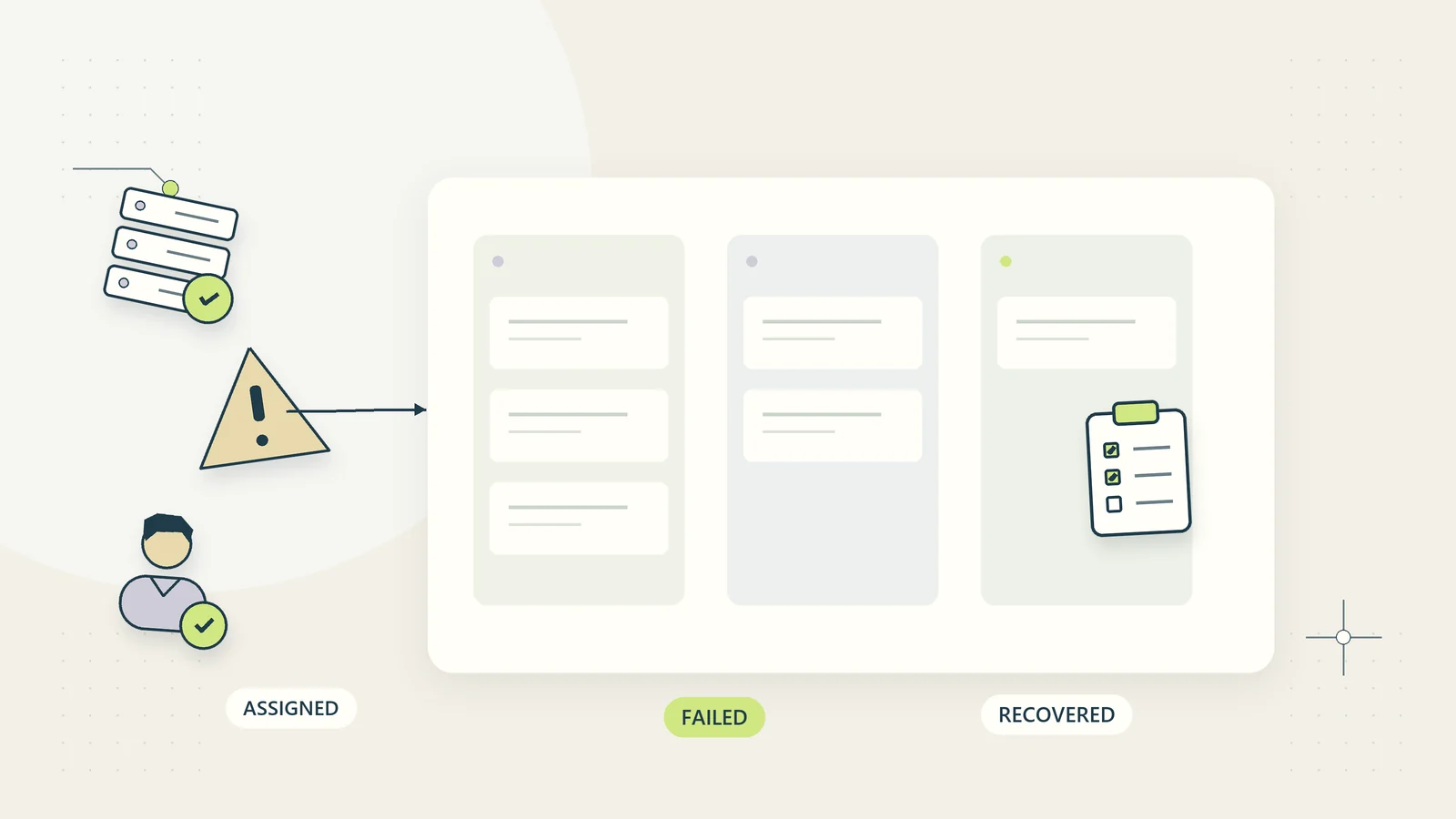
An automatic process needs somewhere to put work it cannot finish safely. Otherwise a temporary outage becomes a lost customer request, a failed delivery becomes an invisible support problem, or an uncertain payment update is repeated until it creates a duplicate. The failure queue is the place where unfinished work retains its identity, its evidence, and a next action.
A useful queue supports automatic recovery for known situations and controlled intervention for the rest. It can begin as a small database table and a restricted staff view. The important design decisions are what counts as failure, when another attempt is safe, who owns the unresolved item, and what proves that recovery is complete.
This guide describes a platform-neutral operating design. Its examples are hypothetical. They explain how to evaluate your own process; they do not represent a tested integration, a promise of uninterrupted service, or a requirement to buy another application.
Define the business outcome before the error message
Start with the outcome your customer or colleague needs. “Download entitlement available for the paid order” is an outcome. “Job returned status 200” is technical evidence that may help establish it. Those two things can diverge: a request may succeed without returning a response, or a worker may report success after updating the wrong record.
For each automated process, write a completion statement and a short list of things that must never happen. A digital delivery process might require one valid entitlement for the correct product and customer. It must not create access for an unpaid order, expose another customer’s file, or send repeated messages because a worker restarted.
Put those statements beside the queue design. They determine what recovery must check. The companion guide to automatic digital product delivery explains how customer access and recovery routes fit into the wider transaction.
Distinguish a failed attempt from an unfinished case
An attempt is one execution. A case is the business item that still needs a result. Keep them separate. Five attempts to deliver one order should create one visible case with five attempt records, rather than five unrelated tasks that different people might replay.
Give the case a stable internal identifier and link it to the relevant order, request, document, or record. Give each attempt its own timestamp and result. Preserve the first failure time so a new attempt cannot make old work appear young.
This distinction also improves reporting. A system can have many transient failures but few affected customers, or one stubborn failure affecting a large batch. Count both technical attempts and unfinished business cases. Neither number alone explains the operational impact.
When work arrives through several channels, define which existing identifier connects the messages. Similar names or identical amounts are weak evidence. Two customers can buy the same item for the same price on the same day.
Create a small set of meaningful states
Use states that tell the next operator what can happen. A practical starting model is new, scheduled for retry, investigating, waiting for a decision, recovered, and closed without completion. Add a separate paused state for a wider incident that makes further attempts inappropriate.
| State | What it means | Required next information |
|---|---|---|
| New | Failure is recorded and unassessed | Classification and owner |
| Scheduled for retry | A permitted automatic attempt is planned | Next attempt time and remaining budget |
| Investigating | Someone is checking the outcome or cause | Named owner and next review time |
| Waiting for a decision | Recovery needs authority or corrected information | Decision required and decision owner |
| Recovered | The intended outcome has been verified | Verification evidence |
| Closed without completion | Work was deliberately stopped | Reason and customer or internal follow-up |
Avoid using “done” for both recovery and abandonment. A cancelled order may need no further delivery, but it is different from a successfully delivered order. That distinction matters when you review customer experience later.
Keep enough evidence without collecting everything
A queue item needs a process name, case identifier, affected record reference, first failure time, last attempt time, current state, owner, classification, next action, and next review time. Include the process version so you can see whether a new release introduced a pattern.
Store a short error category and a link to restricted diagnostic information where necessary. Avoid copying complete customer messages, authentication tokens, payment details, or confidential files into a general operations dashboard. A reference is often sufficient for the first person assessing the problem.
Record what the worker knows, including uncertainty. “Response timed out; destination outcome not yet checked” is more useful than “delivery failed” when the destination may already have accepted the request. It points the investigation toward verification before repetition.
Use the principles in designing a business audit trail to connect decisions and attempts without turning the queue into a second uncontrolled store of customer information.
Classify failures by the action they permit
The first classification should guide recovery. Useful groups include temporary availability, request limit reached, invalid input, permission or credential issue, unexpected business state, uncertain external outcome, and internal software defect.
A temporary outage may permit a bounded retry. A missing required field generally needs corrected information. A permissions failure should go to the person responsible for the connection; repeatedly sending the same request will not grant permission. An unexpected state might mean an order was cancelled while delivery was waiting.
Create an “unknown” category and make it visible. Operators should not force a poorly understood failure into a convenient group just to enable an automatic retry. The queue should show where your rules lack enough evidence.
If AI helps classify a message, keep the original event category and the model’s suggestion distinct. The suggestion can help routing, but it should not grant new financial authority or turn an uncertain result into a confirmed one.
Make automatic retries bounded and conditional
AWS’s guidance on controlling retry calls recommends limits, increasing delays, and randomized timing. The general lesson for a small business is to avoid an uncontrolled loop that adds load while a service is struggling.
Set a retry budget for each class of operation. The budget includes a maximum number of attempts, a maximum elapsed period, and conditions that stop further attempts. Respect documented destination instructions where applicable. A retry policy for refreshing a public reference record should not automatically become the policy for a refund or a customer notification.
Recheck the business state immediately before execution. Work that was valid when queued may no longer be appropriate. A cancelled purchase should not receive a new entitlement just because an old scheduled attempt finally became due.
When the budget is exhausted, change the case state and assign a next action. Do not leave it indefinitely marked “retrying” when no future execution is actually scheduled.
Check uncertain outcomes before replaying actions
A timeout tells you that the caller did not receive a timely answer. It does not necessarily tell you that the destination did nothing. That uncertainty matters when an action creates a record, sends a message, allocates access, or changes money-related information.
The Amazon Builders’ Library explains how idempotent APIs make retries safer: a repeated request can express the same original intent without creating additional effects. Availability and exact behavior depend on the specific operation.
For your process, ask the implementer how duplicate prevention works, how long the relevant identifier remains valid, and how an already completed action can be recognized. Do not assume every endpoint or application supports the same protection.
Where safe replay cannot be established, investigate the destination using the original transaction reference. If the result remains ambiguous, keep the case open for a controlled decision. A slower confirmed recovery can be preferable to creating a second business problem.
Assign authority as well as ownership
Every unresolved case needs one current owner. That person coordinates progress; they do not necessarily have permission to perform every recovery action. A support colleague may verify the customer-facing symptom, while an administrator repairs access and an authorized finance colleague decides a financial adjustment.
Write these limits into the operating procedure. For example, support may resend an existing valid access link after identity checks, but may not create a new paid entitlement without evidence of payment. The technical maintainer may repair a worker without deciding whether a disputed order should be fulfilled.
Document the backup owner and the trigger for escalation. The article on small-business process ownership provides a useful model for keeping responsibility clear when several people contribute.
Automate assignment and reminders where practical. Keep escalation tied to impact, age, and missing decisions, so the owner receives a useful next step rather than another copy of the same error message.
Walk through a hypothetical delivery incident
Imagine a store selling its own downloadable operations workbook. A paid order creates an entitlement, then prepares a transactional email. The email request times out. The entitlement exists, but the worker cannot confirm whether the message provider accepted the email.
The queue creates one case for the order. It records the successful entitlement reference and the uncertain message attempt. The customer can still use the store’s verified order recovery route. Support sees “access available; notification outcome uncertain,” rather than a misleading claim that the whole sale failed.
The recovery routine checks the original message reference if the delivery system supports that lookup. If acceptance is confirmed, the case records that result and stops automatic resending. If the request is confirmed absent and safe retry conditions are met, the worker retries the notification with the appropriate duplicate control.
If the outcome cannot be established, the case moves to a defined decision route. An authorized operator may send a fresh access message after reviewing the situation and recording that choice. The store does not create a second entitlement or charge the customer again to make the queue disappear.
This example separates outcome verification, customer recovery, and technical repair. An automatic business still needs all three designs, even when most cases resolve without personal intervention.
Control bulk recovery during wider incidents
A common underlying problem can create many queue items. Grouping helps you see that pattern, but retain each case’s original identity and completion evidence. A batch label should not erase which customers were affected.
During a widespread incident, pause the relevant automatic action if repeated execution could make matters worse. Record the pause reason, scope, decision owner, and review point. Make sure unrelated workflows can continue where appropriate.
After repair, recover a small verified sample before releasing the whole backlog. Check whether records changed while waiting, whether duplicate prevention still applies, and whether the destination can handle the recovery rate. Keep the ability to pause again.
Prepare customer communication separately from technical diagnostics. Customers need accurate information about their access or request, a useful recovery route, and the next update when appropriate. They rarely need raw exception text or an unsupported promise that every delayed item will complete at a precise time.
Preserve old evidence when a recovery rule changes
A recovery rule can change while unfinished cases are waiting. Record the rule version used for each attempt, and decide explicitly whether older cases should use the replacement. A new default should not silently rewrite the history of why a previous action was permitted.
For example, a product may have been withdrawn after an order entered the queue. The current delivery rule needs to recognize that change and route the order to the appropriate resolution, rather than delivering an obsolete file simply because its old instructions remain available.
Keep a small test set of previously difficult cases. After changing classification or retry behavior, replay synthetic equivalents against the revised process and check the expected business result. That makes maintenance a controlled operating change, with evidence that the fix did not introduce a new unsafe action.
Measure whether the queue improves recovery
Track unresolved case count, age of the oldest case, time to first assessment, time to verified recovery, repeat failure categories, and the number of cases closed without completion. Segment by process and impact so a large number of harmless refresh failures does not hide a single blocked customer purchase.
Also track recovery quality: duplicate actions, reopened cases, incorrect closure, and customer follow-up after a case was marked recovered. A faster closure time is unhelpful if staff close work before the intended result exists.
Review recurring causes with the maintainer. A steady stream of missing fields may call for better input design. Repeated permission failures may reveal weak connection ownership. Uncertain outcomes may require a better transaction reference and verification step.
Use automation ROI analysis to include exception handling and maintenance in the cost of the process. Time spent recovering failures is part of operating the automation, even when the original sales case ignored it.
Run a controlled pilot before trusting the queue
Choose one low-risk process and use synthetic records. Test a temporary outage, invalid input, a duplicate event, a timeout after destination acceptance, an expired retry budget, an owner absence, and a cancelled business item waiting for recovery.
For every test, record the expected state, permitted action, visible evidence, and stopping condition. Confirm that the system preserves one case across multiple attempts and that two workers cannot independently recover the same item. Verify that restricted information does not appear in general alerts.
Set acceptance criteria before the pilot. You might require every simulated unfinished item to appear in the queue, every closure to include evidence, and every uncertain external outcome to stop unsafe replay. These are proposed evaluation criteria, not published performance results.
Start live operation with a narrow scope and a named review date. Expand only after the queue consistently explains what remains unfinished and how it will be resolved. The goal is a dependable recovery path that your business can maintain as its automatic processes grow.
Sources and editorial method
Research checked on October 15, 2026. The operating model, example incident, fields, tables, and pilot criteria are original editorial guidance. The two official engineering references support the limited discussion of retries and duplicate effects. They do not prescribe a particular business tool or certify this design.