Quote to cash for service businesses: a complete handoff map
Map accepted offers, delivery evidence, billing triggers, and payment allocation into one quote-to-cash process for small service and digital-product businesses.
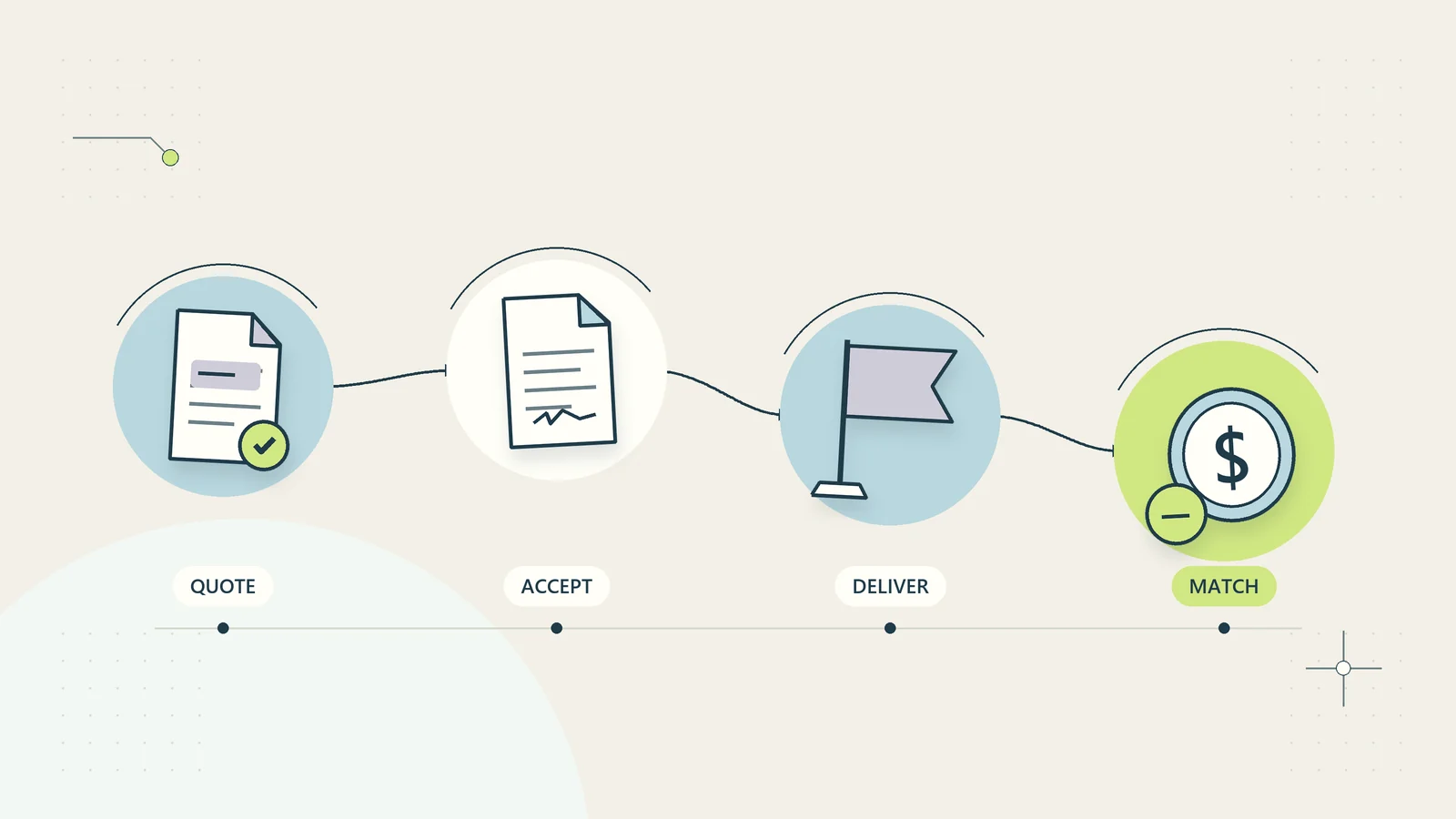
Quote to cash is the path from a specific offer to a correctly allocated payment. In a service business, that path crosses sales, delivery, administration, and bookkeeping. A signed proposal is an important milestone, but it does not tell the delivery team what is ready to begin or tell the bookkeeper which work can now be invoiced.
The practical task is to connect those decisions with usable evidence. Build a shared map that keeps scope, acceptance, delivery, billing, and payment records related without assuming they are the same thing. This guide explains the operating handoffs; your accountant or other appropriate adviser should determine accounting, tax, and contractual treatment for your circumstances.
Set the beginning and end of the process
Choose an explicit start, such as “a complete offer is ready for internal pricing review.” Choose an explicit finish, such as “the payment has been allocated and any remaining balance or exception has an owner.” Without these boundaries, each department can declare its own part finished while the customer still experiences an incomplete transaction.
Salesforce’s quote-to-cash overview describes a process spanning the offer through collection and allocation. Apply that broad boundary to your operating map without assuming your small business needs an enterprise sales system.
For a simple downloadable resource, several stages may happen automatically: the customer selects a product, pays, and receives the correct file. For a service engagement, evidence may include agreed scope, access, completed work, and acceptance. The map should follow the actual product rather than force every business into an identical sales pipeline.
Give the offer a stable identity
Assign each offer an identifier and version. Record the customer or prospective customer, service description, deliverables, exclusions, price, currency, validity, payment terms, and dependencies. Where tax or other required information applies, have the responsible specialist determine what must appear.
Separate the current offer from earlier alternatives. If a client accepts version two after version three was sent, the team needs to resolve the difference before proceeding. Renaming every file “final” or overwriting an old price makes that conversation unnecessarily difficult.
Avoid customer identification by name alone. Two businesses may share a trading name, and one client group may contain several legal entities. Confirm who is buying and where legitimate billing communication should go. Collect only the information necessary for the transaction and its required records.
The service catalog guide helps define repeatable service boundaries. A clear offer is easier to prepare when the business has already decided what each standard service includes.
Check pricing and promises before sending
Use an internal review proportional to the offer’s complexity. A standard fixed-price resource may need only a controlled product record. A custom service can require checks on estimated effort, specialist availability, delivery assumptions, and any unusual payment or acceptance terms.
Give staff explicit limits. Who can approve a discount? Who can promise a rush delivery? Which changes require the owner’s decision? A salesperson should not discover these limits after telling the customer that an exception has been accepted.
Store the decision with the offer rather than in a separate private conversation. Record the reason for a meaningful exception, especially when it affects later delivery or billing. An approved discount does not necessarily approve extra scope, and a delivery concession does not automatically change the payment schedule.
Check the public description against the proposed product. A resource sold as instantly downloadable needs a reliable delivery route. A template should not be described as a fully installed live integration unless that is actually what the seller can provide and support.
Turn acceptance into a delivery-ready handoff
Acceptance should refer to the correct offer version and the agreed acceptance method. Retain the relevant evidence using your approved records process. If the response is ambiguous, clarify it before committing resources rather than translating “looks good” into whatever the team hoped it meant.
Then complete a readiness check. Is the scope settled? Have required prerequisites been received? Is the delivery owner assigned? Does the promised date still fit available capacity? Have any agreed payment conditions been satisfied according to the terms?
The client onboarding process covers access, contacts, and the first delivery milestone. Keep that work connected to the accepted offer so the customer does not have to explain the project again to each person.
Do not ask the customer to supply sensitive credentials inside an ordinary project note. Use the appropriate access method for the task, record who approved access, and remove it when no longer needed. Readiness should make the work possible without building unnecessary copies of customer information.
Use evidence at each handoff
A small handoff table can connect responsibilities without becoming a second copy of every business record.
| Handoff | Evidence to carry forward | Common question to resolve |
|---|---|---|
| Sales to delivery | Accepted offer version, scope, dependencies | What exactly was promised? |
| Delivery to review | Completed items and acceptance criteria | Is this stage actually complete? |
| Delivery to billing | Billing trigger and supporting reference | What can be invoiced now? |
| Billing to collections | Invoice, terms, approved contact | What remains payable and when? |
| Collections to bookkeeping | Payment reference and allocation | Which balance does this settle? |
The receiving person should confirm that the evidence is usable. A delivery team can reject a handoff that lacks a necessary dependency without rejecting the customer. Likewise, bookkeeping can return an unidentified payment for investigation rather than force an allocation based on a similar amount.
Make the rejected handoff visible with a reason, owner, and next action. Otherwise incomplete work tends to move into private inboxes, where it stops appearing in the business’s operating picture.
Keep scope changes connected to money and timing
Service projects often change after acceptance. Record the requested difference, affected deliverables, price implication, delivery implication, and decision owner. Preserve the relationship between the original offer and the approved adjustment.
Do not wait until invoicing to decide whether extra work was included. The client needs a choice while the work can still be changed or deferred. Where a staff member cannot authorize the change, route the request to someone who can rather than treating an internal task assignment as commercial approval.
After acceptance, update the delivery plan and the billing reference together. A change that reaches production but never reaches billing can create unbilled work. A change that reaches billing before acceptance can create an avoidable dispute.
For creative projects, the agency approval and scope guide explains version-specific decisions and consolidated feedback. Those records support the quote-to-cash process by explaining which output and commercial adjustment were actually accepted.
Define the billing trigger in plain language
Your terms may connect billing to a deposit, calendar date, milestone, delivery, usage, or another condition. Translate the agreed trigger into an operational check without changing its meaning. “Project advanced” is a weak trigger; “the specified milestone is complete and the required evidence is recorded” is more usable.
Identify who confirms the trigger and who prepares the invoice or other required billing record. The same person may do both jobs in a very small business, but the two decisions should remain understandable. Have a review route for unusual amounts, credits, tax questions, or customer details.
Keep drafts separate from issued records. If the client changes a billing contact, confirm whether that change affects only communication or also the buyer’s identity. Do not rewrite historical transaction details casually to make an invoice fit a new email address.
This is an administrative design. The correct document, timing, tax treatment, numbering, and correction procedure depend on your jurisdiction and transaction. Use the process to get questions to the appropriate professional rather than embed unreviewed accounting assumptions in an automation.
Distinguish payment messages from allocated cash
A customer saying “paid” is useful information, but the business still needs to verify receipt through the approved financial records. A payment provider’s pending event may not mean funds are settled or the invoice is fully covered. Preserve those distinctions in staff and customer messages.
Match using stable references wherever possible. Check currency, amount, customer, invoice reference, fees, and any partial payment. Two payments of the same amount do not necessarily belong to the same customer. Unidentified funds need an investigation route rather than an automatic guess.
Intuit’s month-end close guidance includes reconciliation between internal records and account statements. Treat ongoing payment allocation as preparation for that review, not proof that the close or accounting judgment has already been completed.
Refunds, disputes, overpayments, and failed payments need their own status and owner. Never remove the original history just to make a balance display look tidy. The records should explain how the current position arose and what action remains. Use the invoice reconciliation planning guide to review matching assumptions before implementing financial record changes.
A hypothetical consulting engagement
Imagine a consultant offers a fixed-scope operational review for a hypothetical price of 2,400 currency units. Offer Q-208, version two, describes two workshops, a findings report, and one review round. Payment terms and any applicable tax treatment are defined separately in the agreed documents; this example does not prescribe them.
The customer accepts the correct version. The consultant records the acceptance and checks that the workshop contacts and source materials are ready. Delivery starts with an assigned owner and a clear first milestone rather than a forwarded sales email containing several old proposals.
Midway through the engagement, the customer requests an additional department’s review. The consultant records a proposed scope adjustment with its fee and scheduling impact. The authorized client contact accepts that adjustment before the extra work begins. Both the delivery plan and the billing schedule now refer to it.
After the relevant billing trigger, the billing record links to the completed milestone. The customer sends a partial payment with the correct reference. Bookkeeping allocates that amount and leaves the remaining balance visible. A follow-up asks about the remaining amount instead of sending a message incorrectly claiming that nothing has been paid.
The final payment is matched through the approved records. The engagement’s operational closure notes the complete deliverable, accepted changes, issued records, and payment allocation. This illustrative case demonstrates connected evidence; it does not represent a client result or an accounting recommendation.
Give exceptions a short, shared queue
Keep a queue for expired offers, disputed acceptance, missing prerequisites, billing questions, unidentified payments, and unresolved credits. Each item should carry its business reference, reason, owner, next action, and review date. Sensitive documents can remain in their controlled location with a reference from the queue.
Review the oldest and most consequential items first, using a transparent rule. A small unidentified payment and a large disputed engagement may need different owners and response times. Avoid relying solely on the date of the most recent message, which can make a long-running problem look new each time somebody replies.
Pause automated follow-ups where a genuine billing dispute is under review. Before sending any reminder, check the latest balance, case status, and communication instructions. A scheduled task should not continue demanding an amount that has already been resolved through another route.
Measure completed handoffs rather than pipeline decoration
Useful measures include accepted offers waiting for readiness, completed work waiting for billing evidence, issued invoices with unresolved questions, and payments waiting for allocation. Separate work volume from age so that a small queue containing one very old problem remains visible.
Measure errors such as wrong offer versions, missing scope approvals, and duplicate reminders. Also review a few successful transactions from beginning to end. Good cases can reveal which small pieces of information made the handoffs easy to perform.
Do not label an accepted quote as cash or count every open proposal as predictable revenue. Forecasting and accounting require appropriate assumptions and professional judgment. Operational tracking should provide reliable inputs, not create certainty from attractive stage names.
Adapt the map for a self-serve digital resource
A first-party digital product can use a shorter route without losing the evidence chain. The offer becomes a controlled product description and price. Acceptance and payment follow the checkout’s documented behavior. Delivery resolves the purchased product to a specific released file and an authorized access record.
Keep the product version and commercial record connected. If the seller replaces a workbook after correcting an error, decide which customers should receive the replacement and how their existing entitlement is checked. A new file uploaded to a folder should not silently change every unrelated product’s download target.
Define financial and delivery recovery separately. A payment can succeed while an email fails. The appropriate response is to verify entitlement and recover access, rather than ask the customer to pay again. Conversely, an unverified browser success message should not grant a downloadable resource without the required payment evidence.
Support should be able to locate the order, product, delivery attempt, and current resolution using one reference. Avoid collecting card details or copying sensitive payment information into ordinary support notes. This compact map allows automatic fulfillment of settled transactions while retaining an understandable route for failed delivery, duplicate events, and customer questions.
Implement one complete path first
Choose one service or digital resource with clear boundaries. Map the real steps, assign owners, and create the minimum evidence register. Test a revised quote, missing prerequisite, approved scope increase, partial payment, and disputed billing record using synthetic examples.
Check that automatic messages and delivery depend on the right event. An accepted quote may prepare onboarding but should not trigger a financial action that has not been authorized. A paid digital order should resolve to the correct released file, with recovery available if access fails.
Run a bounded pilot and review actual exceptions before adding complexity. A dependable quote-to-cash process lets the business explain what was promised, what was delivered, what was billed, and what was received from the same connected history.
Sources and editorial method
Research checked October 15, 2026. Sources are Salesforce on quote to cash and Intuit on month-end close. Brief references establish the process boundary and role of reconciliation. The handoff table, operating checks, and hypothetical consulting engagement are original editorial analysis, not financial advice, a vendor recommendation, or evidence of a live integration.