Coordinate nonprofit donation records and acknowledgements
Connect donation commitments, confirmed payments, purpose reviews, acknowledgements, and corrections with clear handoffs between fundraising and finance.
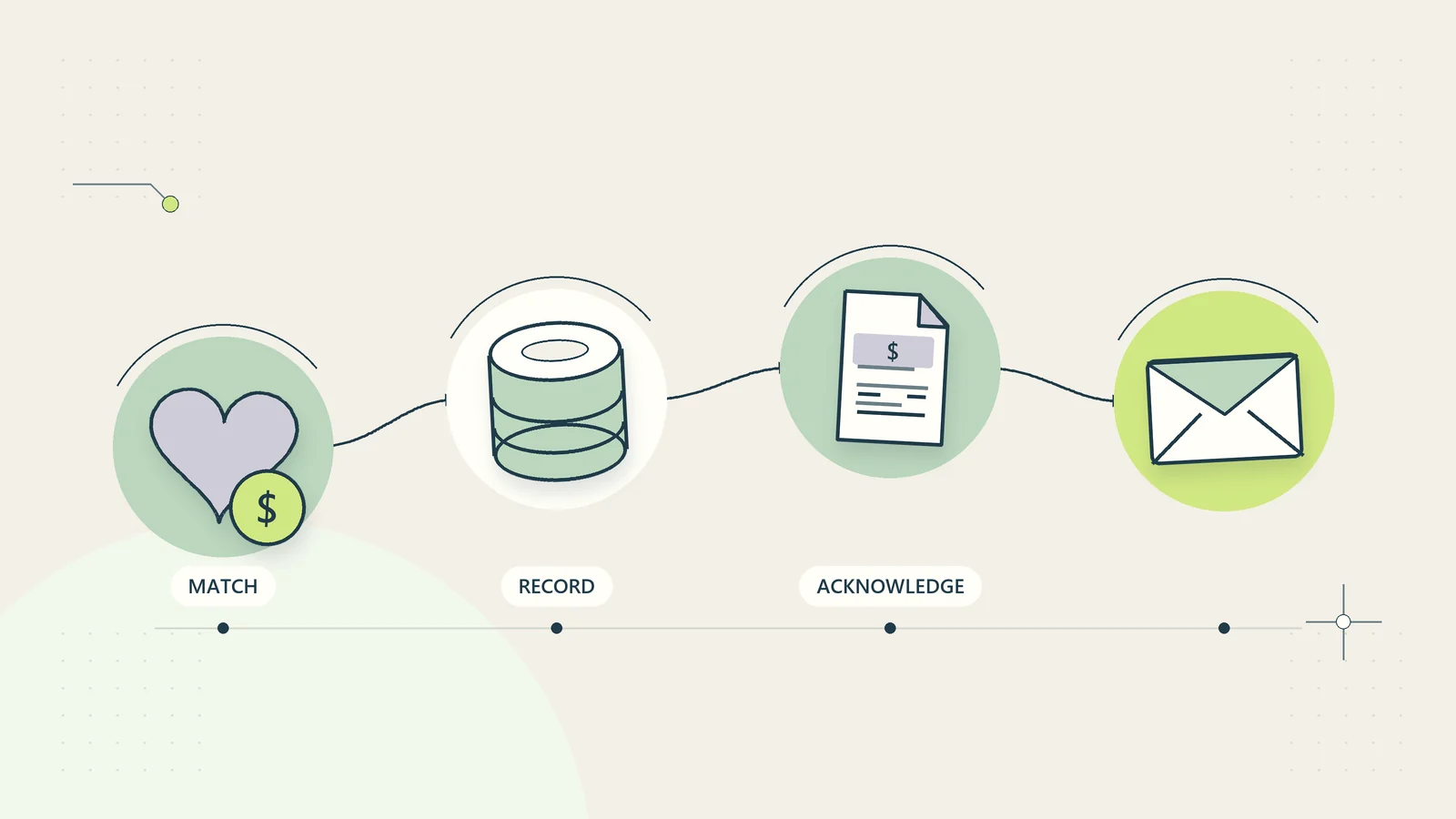
A donation passes through several different kinds of work. Someone makes a commitment, a payment may arrive, finance matches the money, a fundraising colleague thanks the donor, and the organization may need to issue a particular acknowledgement. Those events are related, but they are not interchangeable.
When they are collapsed into a single donated status, a nonprofit can thank someone for a payment that failed, overlook a donor’s restriction, or send conflicting records after a correction. A small, clear handoff process is usually more useful than a larger collection of disconnected spreadsheets.
This guide focuses on administrative coordination. It does not determine tax deductibility, legal donor restrictions, or accounting treatment. Requirements vary across countries, organizational forms, and gift types. The examples are hypothetical and should be reviewed against the nonprofit’s governing documents and applicable professional advice.
Distinguish a pledge, a payment, and an acknowledgement
A pledge describes an intended contribution. A payment record describes an observed financial event. An acknowledgement describes a communication or document issued by the organization. A donor may make one pledge and several payments, or one payment may cover more than one purpose.
Give each event a reference and connect the references explicitly. Record the original currency and amount rather than relying only on a converted total. A payment provider’s net settlement is also different from the donor’s gross payment when fees or currency conversion are involved.
Avoid making a thank-you message the evidence that money arrived. The acknowledgement process should refer to an appropriately confirmed donation record. Likewise, a bank deposit alone may not reveal who gave the money or whether several donations were combined.
The payment reconciliation guide explains how operational records can connect to financial confirmation. Keep fundraising communications and financial reconciliation aligned while preserving their different responsibilities.
Define the minimum donation record
A useful record identifies the donor reference, gift reference, date received or observed, amount, currency, payment channel, campaign or purpose, current confirmation status, and responsible owner. Additional fields depend on the type of contribution and local requirements.
Keep the donor’s own wording for a stated purpose separately from an internal classification. An administrator should not silently convert an unfamiliar instruction into the nearest campaign code. Mark the uncertainty and ask the appropriate person to review it.
Record whether goods, services, event admission, or other benefits may be associated with the contribution. Do not assume that every payment received through a fundraising page is an unrestricted gift with no associated benefit.
For noncash contributions, capture the description and handling reference without automatically assigning a tax value. The relevant finance or specialist owner should decide what additional documentation is required. A generic acknowledgement template is not a substitute for that review.
Assign ownership across fundraising and finance
Write down who confirms payment evidence, who reviews gift purpose, who approves acknowledgement wording, and who resolves donor questions. In a very small organization, one person may perform several roles, but the sequence should still be clear.
Use a second review for changes that could materially affect the financial or donor record. For example, changing the donor identity, reallocating an amount, returning money, or editing a previously issued acknowledgement deserves more control than correcting a formatting error in an internal note.
The Charity Commission’s financial controls guidance applies to charities in England and Wales. It emphasizes appropriate controls for income and donation records, with trustees retaining responsibility. This provides useful context but should not be presented as the governing law for every nonprofit worldwide.
Make absence cover explicit. A shared task queue with a named backup is more reliable than an acknowledgement process that stops whenever the fundraising coordinator is away.
Create a controlled acknowledgement path
Separate a warm thank-you from any document intended to satisfy a particular reporting or tax requirement. Both should be accurate, but the required content and review may differ.
In the United States, the IRS explains charitable contribution substantiation and disclosure requirements. Its rules distinguish types of contributions and associated benefits. Organizations outside that context should use their own applicable requirements, rather than copying a US template and assuming it works globally.
Maintain approved templates by purpose and jurisdiction where needed. Record the template version used, the gift references covered, issue date, recipient, and delivery status. A corrected acknowledgement should point to the document it replaces so that two conflicting versions do not remain equally authoritative.
Do not promise that a donation is deductible merely because the organization issued a receipt. Keep approved language precise and route unusual gifts, disputed benefits, and donor requests for tax advice to an appropriate qualified person.
Use statuses that prevent premature messages
The operational system should make it difficult to imply a completed event before the evidence exists. Pending, confirmed, and reconciled have different meanings and should be defined in the team’s procedure.
| Record state | What it means | What should happen next |
|---|---|---|
| Commitment recorded | A donor expressed an intention | Follow the agreed pledge process |
| Payment awaiting confirmation | A payment event is incomplete or unverified | Check the authoritative financial evidence |
| Payment confirmed | The required evidence has been checked | Review purpose and acknowledgement requirements |
| Purpose clarification | Allocation or restrictions need a decision | Assign the appropriate reviewer |
| Acknowledgement ready | Required details and wording are approved | Issue through the agreed channel |
| Acknowledgement issued | The document was generated and sent | Monitor delivery exceptions |
| Reconciliation exception | Financial records do not yet agree | Investigate without inventing a match |
A status should not erase a problem elsewhere. A gift can be acknowledged while a settlement fee remains under reconciliation, provided the underlying facts and the organization’s rules support that sequence.
Handle restrictions and campaign coding carefully
Fundraising language can create expectations about how money will be used. Keep the published campaign description, donor instruction, and internal allocation connected. A person reviewing a later question should be able to see what the donor was told at the time.
If the nonprofit cannot accept a stated condition, pause the allocation and follow the organization’s review process. Do not reinterpret the instruction simply to clear the queue. The decision may involve governing documents, local law, donor communication, or returning a contribution.
Distinguish a donor’s preference from a binding restriction only through an appropriate authorized review. Administrators should record facts and route ambiguity, not make legal classifications from a short message field.
Changes should leave a history. Capture the previous code, proposed new code, reason, reviewer, and effective date. A transparent correction is more useful than a perfect-looking spreadsheet that conceals how an amount moved between funds.
Keep donor communication preferences separate
An organization needs a reliable way to deliver essential donation communications. That does not mean every donor should automatically receive fundraising campaigns, newsletters, or public recognition.
Record preferences for each relevant purpose and respect requests for anonymity. Public acknowledgement, internal donor identification, and financial recordkeeping serve different purposes. A donor can be anonymous in a public report while the organization still maintains the records it appropriately needs.
Minimize personal information in routine notifications. An administrator may only need the gift reference and an action request, not a copy of the donor’s address, message, and financial details in every email.
Use the customer data sharing checklist as an administrative prompt for recipient, purpose, and minimum information. Adapt it to donor relationships and the nonprofit’s applicable privacy obligations rather than treating charitable intent as permission to share broadly.
Manage failed delivery and duplicate records
A sent message is not always a delivered message. Track bounced acknowledgements as work requiring a defined response. Check the contact information through an appropriate route without repeatedly creating new donor records.
Possible duplicates need review before merging. A shared household address does not prove that two donations came from the same legal donor. A company contact’s email does not establish whether a contribution came from the individual or the company.
Keep financial references stable during a merge or correction. Preserve the original record history and identify who approved the change. If acknowledgement wording depends on identity, assess whether a corrected document is needed after the identity is confirmed.
For duplicate payment notifications, recognize the same underlying transaction rather than recording a new gift for every message. A reliable event reference helps avoid double counting and duplicate thank-you sequences.
Work through a hypothetical campaign handoff
Imagine a community nonprofit receiving a contribution of 300 local currency units for an equipment campaign. The online form records gift G-083 and the donor’s instruction. The payment notification initially says pending, so the system records the event without issuing a final acknowledgement.
Finance later confirms the payment against the appropriate source. The gross gift is 300, while a fee means that the settlement amount is lower. Both amounts are recorded in their relevant places rather than treating the settlement as the donor’s original contribution.
The donor’s message mentions a specific project location that is not included in the campaign description. The fundraising owner routes that condition for review before assigning the gift to an unrestricted category. The approved outcome and communication are recorded.
Once the acknowledgement details are approved, the organization issues document A-083 using the current template. The delivery message bounces. The gift remains confirmed; a separate communication exception asks the owner to verify the address and arrange an appropriate replacement delivery.
Nothing in this example establishes a tax treatment or a legal interpretation. It shows why payment, purpose, document issue, and communication delivery need separate evidence.
Review refunds, reversals, and corrections
A later reversal should update the donation history without deleting the original event. Connect the reversal reference to the affected gift, record the reason and evidence, and identify the person responsible for any donor communication or replacement acknowledgement.
Do not let a repeated old notification restore a gift that has been reversed. The current authoritative financial position matters more than the order in which messages happen to arrive.
For returned contributions, follow the organization’s approval and payment controls. Confirm the legitimate recipient through an appropriate process. A message asking for money to be returned to a different account should not be treated as a routine address correction.
At reporting time, review outstanding exceptions with finance rather than hiding them inside an overall total. The month-end close checklist can be adapted to coordinate evidence, open questions, and review dates without replacing nonprofit accounting requirements.
Pilot the handoffs and measure the unresolved work
Start with one donation channel and one common gift type. Document how the current team identifies donations, checks payment, approves wording, and handles delivery failures. Include recent difficult examples rather than only the simplest online gifts.
Measure the number of gifts missing a financial reference, acknowledgements awaiting information, duplicate records requiring review, and unresolved delivery exceptions. Track the age of each queue and identify who can move the oldest cases forward.
Choose success criteria before the pilot. For example, every confirmed gift should have a traceable purpose review and acknowledgement decision, even if the decision is that additional specialist review is needed. A fast message with the wrong donor or amount is not success.
Pause automatic issue if a template uses the wrong entity name, the wrong gift amount, or an unsupported tax statement. Preserve affected references, correct the rule, and check which documents need review. Automation is useful when it reduces repeated administration while maintaining truthful records and a workable correction route.
Prepare an orderly reporting handoff
Before a campaign report or annual acknowledgement run, create a defined cutoff and identify the records included. A report should state whether it describes commitments, confirmed gross donations, net cash received, or another approved basis. Mixing those measures can produce a persuasive total that nobody can reconcile.
Ask finance to review the connection between the operational gift list and the financial records. Ask fundraising to review donor names, recognition preferences, campaign descriptions, and outstanding communication promises. These are complementary checks, not competing versions of the truth.
Keep a short exception schedule alongside the report. It might show a payment awaiting identity confirmation, an allocation under review, or a corrected acknowledgement not yet delivered. Include the responsible owner and next review date, without exposing unnecessary donor details to everyone reading the summary.
If a figure changes after publication, preserve the earlier report and explain the correction through the approved process. Quietly replacing a spreadsheet leaves colleagues unable to understand why their figures differ. A version note stating which gift references changed and why is more useful than an unexplained new total.
Finally, check that the public story matches the approved purpose and evidence. An operational dashboard should not be used to claim that a project outcome has already occurred merely because its fundraising target was reached. Delivery of the charitable activity needs its own accountable record.
For a recurring gift, distinguish the donor’s ongoing instruction from each individual financial event. A successful installment last month does not prove that the next one succeeded. The acknowledgement process should use the actual confirmed events covered by its wording, and a failed installment should create an appropriate operational question rather than silently reducing or increasing an annual total.
When a donor asks for a historical summary, identify the period and the records included. Check for corrections or reversals affecting that period before issue. This gives the donor and the organization a shared reference, while leaving any tax interpretation to the relevant qualified adviser and applicable rules.
Sources and editorial method
Sources checked on October 15, 2026. This article provides original operational recommendations and a hypothetical example, supported by limited summaries of official guidance. Country-specific sources retain their stated jurisdictional scope. No tax outcome, legal classification, or tested integration is claimed.
- IRS: Charitable organizations, substantiation and disclosure requirements — United States charitable contribution context.
- Charity Commission: Internal financial controls for charities — guidance for charities in England and Wales.