How to delegate recurring work with clear decision limits
Delegate recurring work with clear outcomes, practical decision limits, a learning sequence, review rules, and a measured handover pilot.
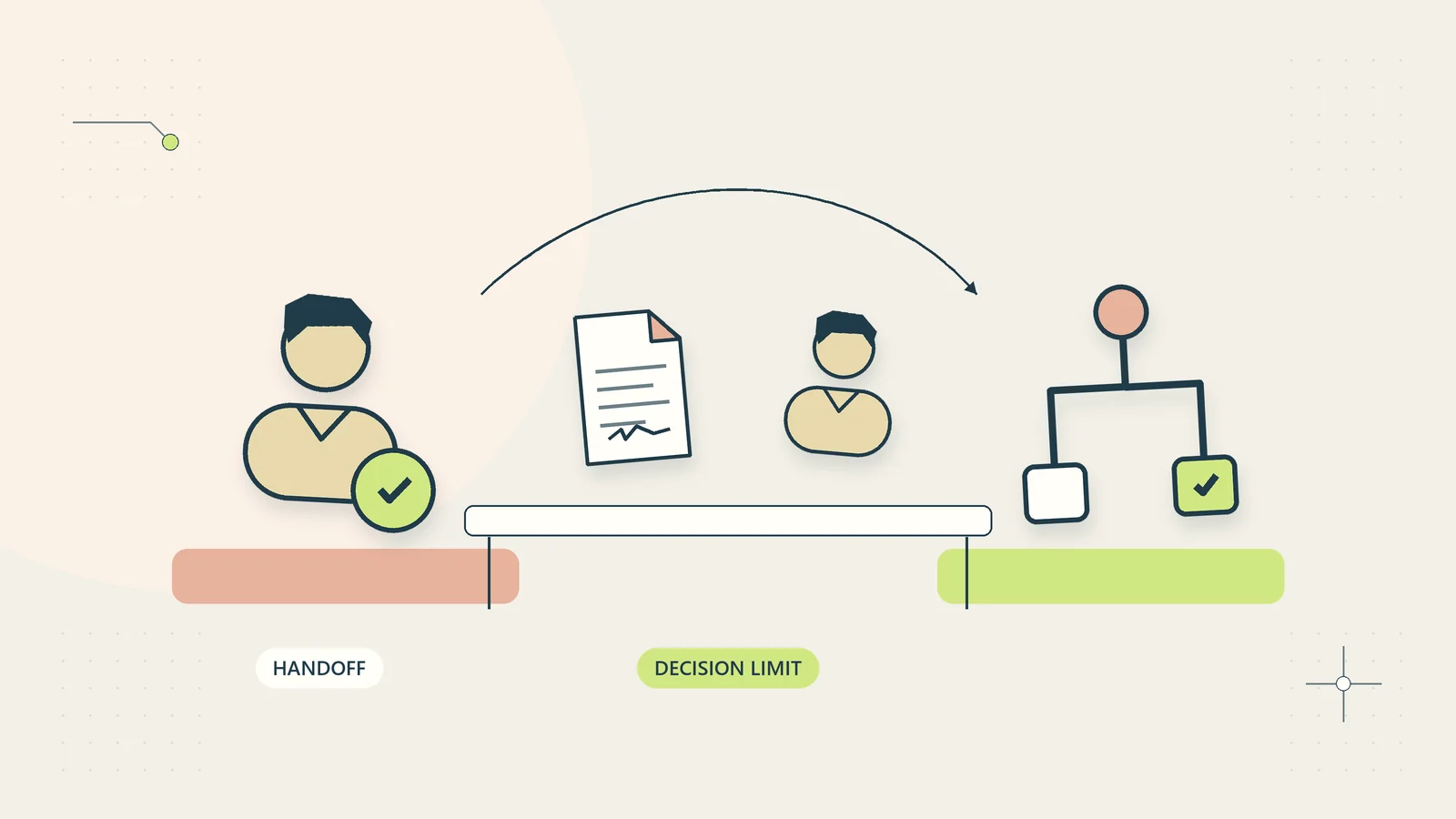
Delegating recurring work becomes easier when the person taking it over can tell which decisions belong to them. A task description such as “handle client administration” transfers activity without transferring enough authority to finish it. The result is often a queue of questions returning to the owner.
A workable delegation agreement connects an outcome, a repeatable method, and clear decision limits. It also explains what happens when the normal method does not fit. You can build that agreement in a shared document and a simple task register; a new software subscription is not a prerequisite.
This guide focuses on recurring operational work such as preparing project folders, checking submissions, coordinating document requests, and maintaining service records. It offers an original delegation worksheet, an illustrative example, and a measured pilot. It does not assume that sensitive professional decisions can be transferred to an unqualified employee or an automated system.
Choose a result that can be handed over
Start with a bounded result rather than an entire function. “Prepare each new project for delivery” can still hide access setup, commercial approval, scheduling, and customer communication. A smaller result might be “create a complete project record after the accepted proposal arrives.” That has a recognizable beginning and a checkable ending.
List the work you currently repeat over a normal operating cycle. Beside each item, note its frequency, approximate handling time, consequence of an error, and number of questions it usually creates. This is a selection exercise, not a performance ranking of employees.
Good initial candidates have stable inputs and an observable result. Avoid choosing the most chaotic or consequential task merely because it consumes your attention. Begin where you can explain the rules and recover from an ordinary mistake. If the workflow itself is unclear, first use the process mapping guide to identify its actual steps.
Agree what remains outside the assignment. A coordinator preparing an invoice pack may gather delivery evidence and confirm customer details without deciding tax treatment, approving a disputed fee, or changing payment instructions. Stating those boundaries prevents an administrative role from quietly acquiring a different responsibility.
Write the delegation agreement on one page
Use a short agreement that answers the questions someone would otherwise ask in chat. Link to detailed instructions rather than pasting an entire manual into the task description. Keep the agreement beside the recurring task so that it is available when work begins.
| Agreement field | A useful answer contains |
|---|---|
| Trigger | The event or schedule that makes the work eligible to start |
| Outcome | The record, decision, or deliverable that must exist at the end |
| Inputs | Required information and where to find the current version |
| Owner | The person responsible for moving this instance forward |
| Decision limits | What the owner may decide, propose, or must escalate |
| Evidence | How completion and important choices will be recorded |
| Review | Which instances receive a check and by whom |
| Coverage | The backup owner and the route for unavailable reviewers |
Ask the recipient to describe the assignment back in their own words. Listen for differences in interpretation. If you intend a draft and they expect to send the final document, the conversation has identified a real operating risk before it becomes an incident.
Atlassian’s roles and responsibilities guidance distinguishes roles from specific duties and addresses work with overlapping ownership. The practical agreement here goes further into the boundaries of one recurring assignment; it is an original worksheet rather than a reproduction of that exercise.
Separate doing, deciding, and approving
An employee can own progress without holding every approval right. Distinguish three kinds of authority: performing an established step, choosing within an agreed range, and approving an exception. For each material choice, specify which kind applies.
For instance, a project coordinator may correct an obvious internal spelling mistake, choose an available internal delivery slot, and request missing evidence. They may need approval to change a promised delivery date or accept a new service requirement. The distinction should follow consequence and competence, not the seniority implied by a job title.
Use explicit verbs: prepare, check, choose, recommend, approve, publish. “Manage” and “handle” are useful summaries but weak instructions for a disputed case. Replace “manage changes” with “record the requested change, estimate the operational effect, and route it to the service owner for approval.”
For larger decisions, a named decision maker can be useful. Atlassian’s DACI framework separates the person driving a decision from the approver and contributors. You do not need to introduce the full framework for every small task. Its relevant lesson is to make the final decision right visible rather than assuming that everyone consulted must approve.
Define limits that match the actual risk
Decision limits can concern money, time, information, quality, or external commitments. A monetary limit alone will not catch a seemingly free action that exposes confidential information or changes a customer promise.
Write limits as conditions that someone can recognize. “Escalate unusual cases” leaves the definition of unusual to the least informed person. A clearer condition is “stop if the accepted proposal and the project record name different legal customers.” Include who to contact, what evidence to attach, and what can continue while the issue is reviewed.
| Situation | Default operating response |
|---|---|
| Required input is missing | Request it using the approved message and leave the instance waiting |
| Two authoritative records disagree | Preserve both references and ask the named decision owner |
| Customer requests more scope | Record the request without promising acceptance |
| Action requires broader access | Ask for an access decision rather than borrowing credentials |
| Completion would break an agreed standard | Hold the affected step and document the exception |
These are starting patterns, not universal rules for every business. Adjust them to your obligations and the expertise of the people involved. Test boundaries using real categories of past exceptions, with customer details removed where they are unnecessary.
Give access and instructions together
A person cannot own a task they cannot perform. Before the pilot begins, check access to the current procedure, source records, destination, and exception register. Use individual accounts with permissions appropriate to the assignment. Shared passwords create uncertainty about who acted and make later access removal harder.
Provide a short procedure for unfamiliar work and a checklist for recurring control points. Link to the guide to writing useful SOPs when the steps need explanation. A checklist that says “check the record” is insufficient if the recipient has never learned what a correct record looks like.
Include one normal example and one exception example. Remove unnecessary personal information from training copies. Mark examples clearly so that nobody mistakes a fictional customer or obsolete bank detail for a live record.
Check that the agreed authority exists in the tools as well as the document. If someone may draft but not publish, the system should support that separation where practical. If it cannot, compensate with a visible review state and a narrower assignment until the operating method is reliable.
Transfer the task through a short learning sequence
Begin by demonstrating a complete instance and explaining the choices that are not obvious from the screen. Then have the recipient perform an instance while you observe. Let them explain why an input is acceptable and why a particular branch applies.
Next, move to independent execution with a review before consequential actions. Reduce that review only when evidence supports the change. Completing two easy cases does not prove readiness for a category of exceptions that has not appeared yet.
Agree on a temporary question channel and response expectation. Otherwise the learner may wait indefinitely or interrupt you repeatedly because they cannot tell which questions require immediate attention. Group nonurgent questions into a visible list, but keep an immediate route for actions that could create an external commitment.
Avoid silently taking the task back when an instance becomes difficult. If you need to intervene, record what happened and return ownership explicitly afterward. The recipient should know whether they are still responsible for the remaining work. This prevents a temporary rescue from becoming permanent ambiguity.
A hypothetical handover of project setup
Consider a fictional four-person design studio. The owner currently creates a project folder, copies the accepted scope, checks the customer’s chosen contact, and prepares an internal delivery record. A coordinator will take over those administrative steps.
The trigger is an accepted proposal stored in the designated location. The coordinator may create folders, apply the standard naming pattern, and request missing contact details. They may not reinterpret the proposal, add deliverables, or promise a delivery date that has not been approved.
Completion requires a project identifier, a link to the accepted proposal, the named customer contact, the internal delivery owner, and a short setup checklist. The delivery owner accepts the record before substantive work begins. Incomplete information produces a waiting state with a named next action, not a falsely completed setup.
During a hypothetical pilot, one customer sends a revised document after acceptance. The coordinator preserves it as a new submission and routes the difference to the owner. They do not overwrite the accepted scope. This response demonstrates the intended decision boundary even though the routine task takes longer in that instance.
The studio can evaluate the pilot by examining setup completeness, clarification questions, rework, and owner intervention. Any time saved is an observation to measure, not an outcome assumed by this example. The coordinator’s successful handling of the exception matters more than the number of checkboxes completed quickly.
Keep review useful without recreating the bottleneck
Review should test the important decisions and evidence. Repeating every operational step yourself after someone else performs it creates duplicate work and signals that responsibility has not transferred.
Start by reviewing all instances that involve a consequential external action or an unfamiliar exception. For lower-risk routine work, consider a defined sample after the initial learning period. State the sample method so that neither person assumes a check happened when it did not.
Record review findings as specific corrections: an incorrect source reference, a missing acceptance check, or an escalation sent to the wrong owner. Separate a procedure defect from an execution mistake. If three competent people misread the same instruction, rewriting the instruction may be more useful than repeating the training.
Use the operations dashboard guide to choose a few measures that support a decision. A rising count of questions might indicate careful learning rather than deteriorating performance. Read the cases behind the number before changing authority or judging the recipient.
Plan coverage and revocation before they are needed
Recurring work continues during leave, illness, and role changes. Name a backup and specify how they learn that coverage is active. A list of three possible substitutes is not equivalent to one person accepting responsibility for the next instance.
Document which decisions a backup may make. They may have less context than the usual owner and need a narrower boundary. Keep pending exceptions visible so that a covering employee does not restart a conversation or act on an outdated answer.
State how authority can be paused or changed. A new customer category, service, or access requirement may make the original agreement unsuitable. Pausing an unsafe branch should not automatically suspend harmless administrative work elsewhere in the process.
When a role ends, transfer open instances and remove access through the normal offboarding process. Update the procedure owner and the recurring schedule. Delegation is incomplete if a former employee remains the hidden recipient of reminders or the sole owner of a critical document.
Run a measured delegation pilot
Choose a small, representative set of instances and an operating period that includes the normal cycle. Record a baseline for owner handling time, completion quality, and recurring clarification questions before transferring the task. Do not claim a gain from moving work to someone whose time you have not counted.
Track the recipient’s handling time, reviewer time, waiting time, and correction effort separately. A task that takes fewer minutes of the owner’s time may still increase total effort while the recipient learns. That can be an acceptable investment, but it should be visible.
Set continuation rules before reviewing results. You might require every instance to have a complete source reference, no unauthorized commitments, and a workable exception route. Decide whether the next step is independent operation, another supported cycle, a narrower assignment, or a redesigned procedure.
Finish by revising the delegation agreement with what the pilot revealed. Connect the assignment to your recurring task system so that ownership survives beyond the initial handover conversation. The useful result is a repeatable transfer of responsibility with understood limits, supported by evidence from your own operation.
Check whether authority has actually transferred
At the end of the pilot, ask the recipient to describe three decisions they can now make and three that still require approval. Compare the answers with your own understanding. A difference is a reason to clarify the agreement, even if the observed instances happened to finish correctly.
Then inspect the surrounding behavior. Are customers and colleagues still bypassing the new owner to ask you routine questions? Are you giving private instructions that contradict the documented method? Transfer the relevant context back into the shared record and redirect ordinary requests to the agreed owner.
Keep a boundary between support and approval. Offering advice does not necessarily mean taking back the decision. Say explicitly when you are providing input and when you are exercising an approval right. That distinction helps the recipient become capable without having to interpret every conversation as a hidden instruction. Revisit it when the service or the person’s responsibilities change.
Sources and editorial method
Checked on October 15, 2026. This guide combines current official descriptions of responsibility and decision frameworks with original operational analysis. The project setup scenario, worksheet, limits, and pilot design are illustrative; they are not reported client results or a claim of tested software integrations.
- Atlassian: Roles and Responsibilities informs the brief distinction between a role, specific duties, and overlapping ownership.
- Atlassian: DACI decision-making framework supports the brief explanation of separate driver, approver, and contributor roles.